SEO vs GEO vs AEO: Check and Optimize Your Website with DevToolbox
Search engine optimization is no longer just about ranking web pages on Google. As AI-powered search experiences become more common, website owners must also think about how their content answers questions and how easily it can be understood by generative AI systems.
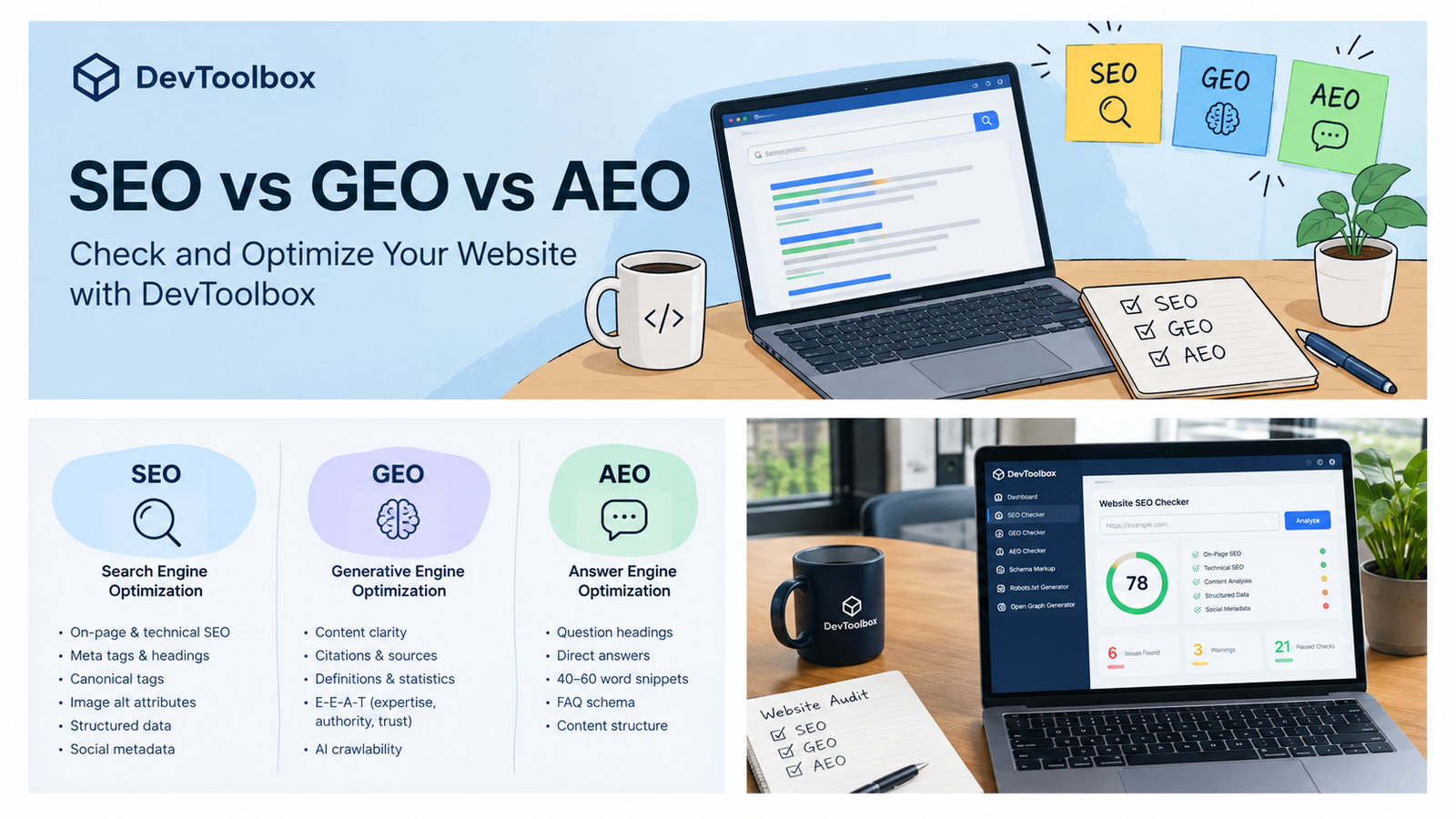
This is where three important concepts come into play: SEO (Search Engine Optimization), GEO (Generative Engine Optimization), and AEO (Answer Engine Optimization).
Although they share some common principles, each focuses on a different aspect of online visibility. Understanding these differences can help you identify weaknesses in your website and make informed improvements.
With the free DevToolbox Website SEO Checker, GEO Checker, and AEO Checker, you can review supported website elements, discover optimization opportunities, and build a more structured approach to website improvement.
In this guide, we'll explain how SEO, GEO, and AEO work, what each checker helps you evaluate, and how to use them together.
What Is SEO, GEO, and AEO?
Before choosing an optimization tool, it helps to understand what each approach means and why it matters.
1. SEO: Search Engine Optimization
Search Engine Optimization (SEO) involves improving a website's technical accessibility, content, and relevance so search engines can discover, understand, and potentially rank its pages for relevant searches.
Traditional SEO remains an important foundation for website visibility.
Common SEO elements include:
Title tags: Describe the main topic of a page.
Meta descriptions: Summarize page content and may appear in search snippets.
Heading structure: Organizes information into meaningful sections.
Canonical tags: Signal the preferred URL when duplicate or similar pages exist.
Image alt attributes: Provide text alternatives for meaningful images.
Robots directives: Communicate instructions related to crawling and indexing.
Structured data: Describes supported information using machine-readable markup.
Social metadata: Helps control how content is presented when shared on supported platforms.
Missing or incorrectly configured elements can make a page harder to interpret or create technical issues that deserve investigation.
Try it: Use the free Website SEO Checker to analyze a webpage's supported on-page SEO elements and identify issues worth addressing.
2. GEO: Generative Engine Optimization
Generative Engine Optimization (GEO) focuses on improving the usefulness, clarity, and discoverability of website content in AI-powered search and generative answer experiences.
For example, a user might ask an AI search platform:
"Which website monitoring tools are suitable for a small business?"
An article that provides meaningful comparisons, explains important differences, and supports its claims may offer more value than a page containing only generic descriptions.
Useful GEO practices include:
Writing accurate, informative content.
Providing clear definitions and explanations.
Supporting factual claims with relevant sources.
Including meaningful statistics when reliable data is available.
Demonstrating experience and expertise where appropriate.
Making important content accessible to search crawlers.
Adding original examples, insights, and useful comparisons.
GEO does not have a guaranteed formula. AI platforms use different systems to retrieve, interpret, and select information, and no checker can guarantee that a website will be cited in an AI-generated response.
Try it: Run your page through the DevToolbox GEO Checker to review supported signals involving citations, definitions, statistics, E-E-A-T, and AI crawlability.
3. AEO: Answer Engine Optimization
Answer Engine Optimization (AEO) focuses on making website content effective at answering specific questions.
People often search using complete questions, such as:
What is a canonical URL?
How do I check my website's SEO?
What is the difference between SEO and GEO?
How can I improve my website's visibility in AI search?
Content that addresses these questions directly can make it easier for readers to find the information they need.
Effective AEO practices include:
Using descriptive, relevant question headings.
Providing direct answers before adding supporting detail.
Organizing information into logical sections.
Including FAQs that address genuine user questions.
Using appropriate structured data where supported.
Keeping explanations accurate and easy to understand.
Answer-focused content can support both traditional search and AI-powered answer experiences, although it does not guarantee featured snippets or AI citations.
Try it: Use the DevToolbox AEO Checker to review supported elements such as question headings, direct answers, snippet-length checks, and FAQPage schema.
SEO vs GEO vs AEO: What's the Difference?
Aspect | SEO | GEO | AEO |
|---|---|---|---|
Primary objective | Improve search engine discoverability and relevance | Improve content's usefulness and discoverability in generative AI experiences | Make information effective at answering questions |
Typical focus | Metadata, technical SEO, content, and internal links | Content clarity, evidence, expertise, and AI accessibility | Question coverage, direct answers, and content structure |
What to review | Titles, headings, canonicals, robots directives | Definitions, citations, statistics, E-E-A-T, crawlability | Question headings, answer clarity, snippet checks, FAQ schema |
DevToolbox tool |
These approaches overlap. Strong technical SEO, useful content, and clear explanations can support all three. You do not need to abandon traditional SEO to start improving your content for AI-powered search.
How to Check Your Website's SEO, GEO, and AEO
You can use the three DevToolbox checkers as part of a repeatable website review process.
Step 1: Run an SEO Audit
Start with the technical and on-page fundamentals.
Open the Website SEO Checker, enter the URL you want to inspect, and run the analysis.
Review the available findings for elements such as:
Missing or problematic title tags and meta descriptions.
Heading structure.
Image alt attributes.
Canonical declarations.
Robots directives and related indexability signals.
Available structured data and social metadata.
Address relevant problems and verify the changes on your website.
Step 2: Evaluate Your Content with the GEO Checker
Once the basic SEO elements have been reviewed, look at how well your page communicates information.
Open the GEO Checker, enter your webpage URL, and review the checks available for the page.
Pay attention to whether:
Important concepts are defined clearly.
Factual claims are supported where necessary.
Statistics have appropriate sources.
The content demonstrates relevant expertise.
Important information is accessible to crawlers.
Use the findings to improve the quality and usefulness of your content rather than adding unnecessary keywords or AI-related phrases.
Step 3: Review Question Coverage with the AEO Checker
Now consider the questions your target audience might ask.
Open the AEO Checker and analyze the page.
Review the available checks for question-based headings, direct answers, 40–60-word snippet opportunities, and FAQPage schema.
For example, if you have an article explaining website redirects, readers might want to know what a redirect is, when to use one, and how to troubleshoot redirect loops.
Add clear answers where they genuinely improve the page.
Step 4: Fix Issues and Recheck
Do not treat every warning as equally important.
Prioritize issues that affect accessibility, crawling, content accuracy, or the reader's ability to find information.
After making changes, rerun the relevant checker and confirm that the updated page addresses the identified problems.
Remember that these tools evaluate supported signals. They do not independently confirm Google indexing, predict rankings, or guarantee inclusion in AI-generated answers.
Important Website Elements to Review
A combined SEO, GEO, and AEO workflow becomes easier when you know what to look for.
Title Tags and Meta Descriptions
Every important page should have a descriptive title that accurately represents its content.
Meta descriptions should summarize the page's value in natural language. Google may generate a different search snippet depending on the query, so writing a meta description does not guarantee that the exact text will appear.
Clear Headings and Direct Answers
Organize content using meaningful headings. Where appropriate, answer the main question near the beginning of a section before providing detailed explanations.
This benefits readers and makes the page easier to navigate.
Reliable Sources and Factual Accuracy
Support important claims with trustworthy documentation, original research, or relevant evidence.
For technical articles, linking to official documentation can be especially useful. Do not add citations merely to make content appear authoritative.
Appropriate Structured Data
Structured data can help search engines interpret supported types of information.
If you publish articles, you can explore the DevToolbox Schema Markup Generator to create supported schema markup.
Always verify that generated markup matches the visible page content and follows the relevant specifications. Structured data does not guarantee rich results or AI citations.
Crawlability and Indexability
Check whether important pages are accessible and whether robots directives or canonical declarations may be affecting their discoverability.
You can also use the DevToolbox Robots.txt Generator to explore the site's robots.txt utility. Review your configuration carefully before changing production crawling rules.
Social Sharing Metadata
Open Graph metadata helps determine how a page is represented when shared on supported social platforms.
If your content is not displaying as expected, the DevToolbox Open Graph Generator can help you create relevant social metadata.
Keep in mind that social sharing metadata serves a different purpose from search ranking signals.
Common SEO, GEO, and AEO Mistakes
Even with automated tools, it is possible to spend time on improvements that provide little value.
Mistake 1: Focusing Only on a Score
An audit score is a diagnostic indicator based on the tool's checks. It is not a universal Google ranking score or a reliable prediction of AI citations.
Use the findings to identify specific improvements.
Mistake 2: Adding Keywords Everywhere
Repeating the same keyword in every heading or paragraph can make content difficult to read.
Use relevant terminology naturally and prioritize a complete, useful explanation.
Mistake 3: Publishing Generic AI-Generated Content
AI can help with drafting and editing, but generated content should be checked for accuracy, originality, and practical usefulness.
Add verified examples, meaningful analysis, and insights relevant to your audience.
Mistake 4: Adding FAQ Schema Without a Purpose
FAQs should answer real questions. Structured data must accurately represent the page and comply with applicable guidelines.
Adding FAQ markup does not automatically make a page eligible for enhanced search results or AI citations.
Mistake 5: Ignoring Actual Search Performance
A technically well-structured page may still receive little traffic because of competition, weak search intent alignment, limited demand, or other factors.
Use Google Search Console and appropriate analytics tools to understand impressions, clicks, queries, and user behavior.
Who Should Use the DevToolbox Checkers?
The three tools can be useful at different stages of website development and content optimization.
Website owners and small businesses: Identify common on-page SEO issues and discover opportunities to improve important landing pages.
Developers: Review metadata, canonical declarations, robots directives, and other supported technical signals during development or maintenance.
Bloggers and content creators: Evaluate headings, question coverage, definitions, and content organization before publishing.
SEO professionals and digital marketers: Use automated checks as an initial step in a wider optimization workflow.
Agencies and consultants: Apply a repeatable process when reviewing client pages, alongside manual analysis and search performance data.